
Legacy System Knowledge Transfer: How to Capture What's in the Code Before It's Too Late
The Clock Is Already Running
Every organization running a legacy system is also running a countdown. The developers who built those systems, who know why a particular block of COBOL does what it does or why a PL/SQL trigger fires in that specific sequence, are retiring. When they leave, the knowledge leaves with them. What stays behind is code that works but is no longer fully understood by anyone in the building.
This is not a hypothetical risk. The founding team at Replai came out of HP, Meta, Microsoft, Sapiens, and several leading AI companies. Across those careers, they kept running into the same problem: enterprises running on systems that no single person fully understood. Core banking platforms. Insurance policy engines. Logistics infrastructure. Decades of accumulated business logic, with the original authors long gone and the documentation either missing or wrong.
This guide is for IT leaders trying to get ahead of that problem before it becomes a crisis.
How Knowledge Actually Gets Lost in Legacy Systems
Most organizations assume the risk is about documentation. If they could just write down what the system does, they would be safe. But documentation alone is rarely sufficient, for a few reasons.
- The code has drifted past the docs. Systems built over 15 or 20 years accumulate changes that never made it into any formal record. The documentation describes the system as it was designed, not as it actually runs today.
- The logic is embedded in places people do not look. In Oracle Forms applications, business rules live inside triggers, PL/SQL blocks, and undocumented customizations. In COBOL systems, critical calculations are spread across programs, copybooks, and JCL that interact in ways only long-tenured developers learned to trace. Asking someone to document that from memory produces an incomplete picture at best.
- The experts do not know what they know. Experienced developers carry mental models of how systems behave that they have never articulated. They know the edge cases, the workarounds, the historical context for a strange design decision. That knowledge is tacit. It does not transfer through exit interviews or hastily assembled wikis.
The result is that when a key developer leaves, successor teams are left with a system that runs, but that they cannot confidently change, extend, or replace.
Why the Code Is the Only Reliable Source of Truth
In a mature legacy system, the code is often more accurate than the documentation because the code is what actually runs. Every business rule that has survived in the system is there because someone wrote it into the code, and it has been executing ever since. The documentation may have been accurate once. The code is accurate now.
That sounds straightforward, but the practical challenge is that most legacy codebases are not easy to read. COBOL, PL/I, and aging Java applications written across decades by rotating teams do not announce their business logic clearly. Logic is distributed across many files, many programs, and many layers of abstraction. A developer new to the codebase cannot simply read through it and extract a reliable picture of what the system does.
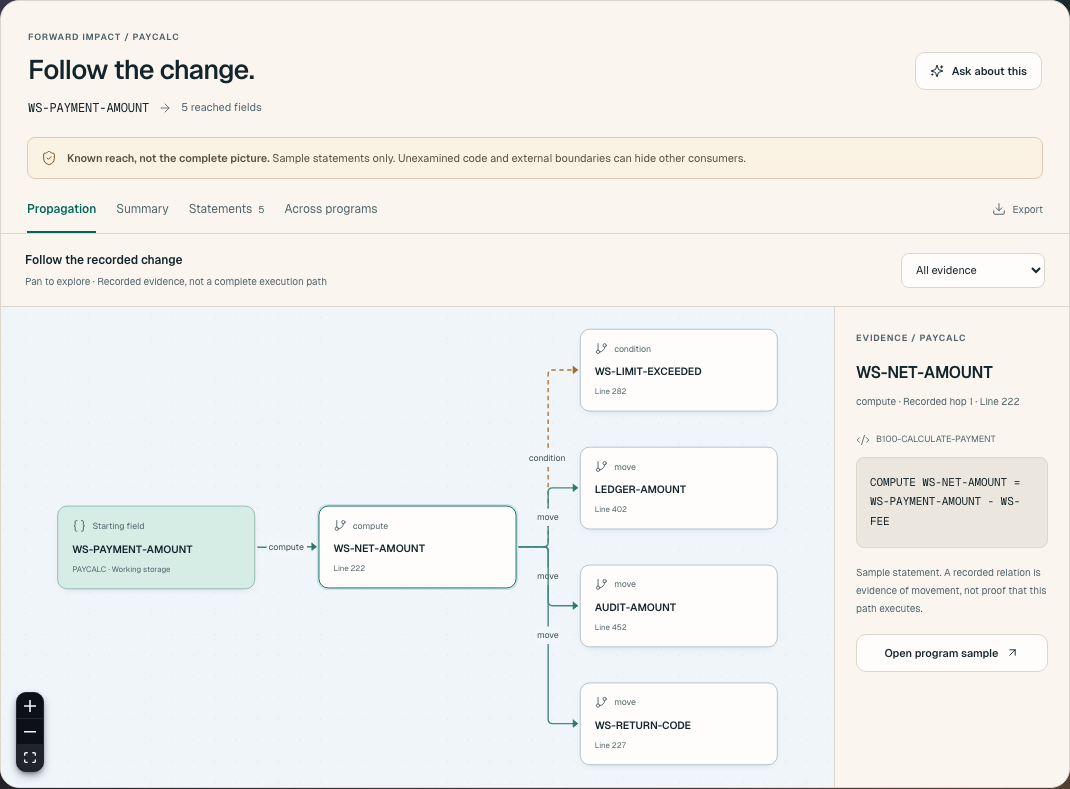
This is where AI-assisted code analysis changes what is possible. Replai's platform maps the business meaning inside legacy codebases, connecting technical components to the business logic they implement. Rather than asking developers to manually trace through thousands of lines of code, the platform surfaces what the system does at a level that modernization teams, architects, and business stakeholders can actually use.
For a team planning succession or preparing for a modernization project, that map is the starting point that has consistently been missing. Learn more about how this works on the legacy code analysis page.
What Organizations Can Do Before Key People Leave
Knowledge transfer planning works best when it starts early, before a retirement date is announced or a resignation lands. A few approaches that hold up in practice:
- Start with the code, not the documentation. Treat the codebase as the primary source of truth and invest in tools that can help you read it systematically. Manual walkthroughs with senior developers are valuable, but they cannot scale to cover a large system thoroughly.
- Identify the highest-risk components first. Not all parts of a legacy system carry equal risk. The modules that handle core business calculations, compliance logic, or complex integration rules deserve the most attention. Prioritize those for structured knowledge capture.
- Use departing developers' time strategically. An experienced developer's last months are most valuable when spent reviewing and validating system maps, not writing documentation from scratch. AI-assisted analysis can produce a draft that a senior developer reviews and corrects, which is a much more efficient use of limited time.
- Plan for modernization alongside succession. Organizations that treat knowledge transfer as a standalone exercise often find that the captured knowledge has a short shelf life. Connecting it directly to a modernization roadmap gives it somewhere to go and makes the effort compound over time.
If your organization is also weighing a broader modernization effort, the guide to AI-assisted legacy code modernization covers how these two efforts fit together.
Where to Start
The hardest part of legacy knowledge transfer is usually getting started. The system is large, the timeline is uncertain, and there is no clean way to scope the work. The most practical first step is an honest assessment of where the knowledge risk actually sits: which systems, which components, and which people carry knowledge that has not been captured anywhere.
Replai exists to help teams make that assessment and act on it. The platform maps the business meaning inside mission-critical systems so that modernization teams, architects, and IT leaders can see what they are working with before anyone touches the code. If your organization is facing a developer retirement, a modernization decision, or both, that visibility is where the work begins.
To see how Replai approaches this problem, visit the solutions page or explore the platform.